

Gutenberg Prints Bible: Movable Type Changes Everything
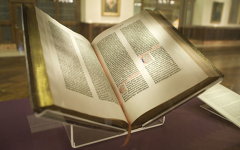
Johannes Gutenberg produced the first copies of his 42-line Bible in his Mainz workshop around 1455, using a system of movable metal type, oil-based ink, and a wooden press adapted from a wine press. The Bible was printed on vellum and paper in editions of roughly 180 copies, of which 49 survive today. Gutenberg's innovation was not the concept of printing, which the Chinese had practiced for centuries, but the creation of a complete system: individual metal letters cast from durable alloy, arranged in a composing stick, locked into a form, and pressed uniformly onto paper. A single press could produce 3,600 pages per day, compared to a monk's output of roughly two pages. The cost of books dropped by roughly 80 percent within a generation. By 1500, an estimated 20 million volumes had been printed in Europe. The monopoly on knowledge held by the Catholic Church and literate elite collapsed, enabling the Protestant Reformation, the Scientific Revolution, and mass literacy.
February 23, 1455
571 years ago
Key Figures & Places



What Else Happened on February 23
Diocletian's soldiers arrived at the church in Nicomedia on February 23, 303, stripped the building, and burned every manuscript they could find. No bloodshed t…
Justinian ordered the Hagia Sophia built after rioters burned down the previous church during the Nika riots — the same riots where he nearly fled the city unti…
Khosrow II lost an empire because he refused to believe his generals. The Sasanian shah had ruled for 38 years, conquered Egypt and Syria, laid siege to Constan…
Wu Zetian ruled China for fifteen years as its only female emperor. She'd clawed her way from concubine to empress to sovereign, killing rivals, promoting schol…
Lautaro had been a Spanish stable boy. He'd fed their horses, watched their drills, learned how they fought. At Marihueñu, he used that knowledge. He let the Sp…
Charles XI became King of Sweden at age four. His regents ran the country for twelve years while he learned to read. When he finally took power at sixteen, Swed…
Talk to History
Have a conversation with historical figures who witnessed this era. Ask questions, explore perspectives, and bring history to life.