

Boxers Rise: China Fights Foreign Domination
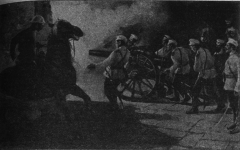
The Boxer Uprising reached its crisis point in the summer of 1900 when militants of the Society of Righteous and Harmonious Fists, supported by elements of the Qing imperial court, besieged foreign legations in Beijing for 55 days. The Boxers, originally an anti-Qing movement, redirected their fury toward foreign missionaries, Chinese Christians, and the technological symbols of Western imperialism (railroads, telegraph lines). Empress Dowager Cixi declared war on all foreign powers on June 21. An eight-nation relief expedition of 20,000 troops fought its way from Tianjin to Beijing, lifting the siege on August 14. The Boxer Protocol of 1901 imposed a crippling indemnity of 450 million taels of silver and allowed foreign troops to be permanently stationed in Beijing.
June 13, 1900
126 years ago
Key Figures & Places


What Else Happened on June 13
Two emperors who hated each other agreed on exactly one thing. Constantine and Licinius met in Milan in February 313, sealed a political marriage, and hammered …
He left home at 21 thinking he'd be back in a year. Ibn Battuta never returned. What started as a hajj to Mecca stretched into 75,000 miles across 44 modern cou…
The oldest military alliance still active today wasn't forged by grand diplomacy — it started as a transaction. England needed wool trade routes. Portugal neede…
Angry mobs led by Wat Tyler stormed and incinerated the Savoy Palace, the opulent London residence of John of Gaunt. By destroying the symbol of royal corruptio…
Henry VIII built the biggest warship on Earth and named it after God. Henry Grace à Dieu — "Henry, Grace of God" — wasn't subtle. At 1,500 tons and carrying 186…

Martin Luther married Katharina von Bora on June 13, 1525, in a ceremony at the Black Cloister in Wittenberg. Katharina was one of twelve nuns who had escaped t…
Talk to History
Have a conversation with historical figures who witnessed this era. Ask questions, explore perspectives, and bring history to life.