

First Punic War: Battle of the Aegates Islands - The Romans sink the Carthaginian fleet bringing the First Punic War to an end.
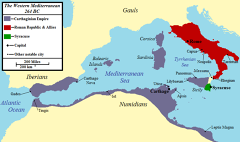
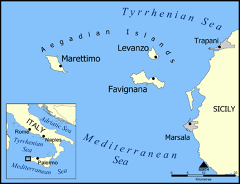
Rome's treasury was empty, its citizens were exhausted, and the First Punic War had dragged on for 23 years when a group of wealthy Romans did something extraordinary: they funded a fleet out of their own pockets. The 200 warships they paid for destroyed the Carthaginian navy at the Battle of the Aegates Islands on March 10, 241 BC, ending the longest continuous war in ancient history and transforming Rome from an Italian land power into the dominant force in the western Mediterranean. The First Punic War had begun in 264 BC over control of Sicily, the rich granary island between Italy and North Africa. Rome, which had no naval tradition, built its first fleet from scratch by copying a captured Carthaginian warship, famously adding the corvus, a boarding bridge that turned naval engagements into infantry fights where Rome's legionaries had the advantage. Rome won early naval victories but suffered catastrophic losses to storms: at least 500 ships and 100,000 men were lost to weather between 255 and 249 BC. By the late 240s, both sides were financially exhausted. Rome had disbanded most of its fleet. Carthage maintained a garrison in western Sicily under the brilliant general Hamilcar Barca (father of Hannibal), who conducted an effective guerrilla campaign from Mount Eryx. The war had settled into a stalemate that neither side could break. The private fleet, organized by Roman citizens who lent the money to the state on the condition that it would be repaid from the spoils of victory, consisted of approximately 200 quinqueremes modeled on a fast Carthaginian warship captured years earlier. The consul Gaius Lutatius Catulus trained the crews through the winter of 242-241 BC and blockaded the Carthaginian base at Lilybaeum. Carthage assembled a supply fleet of roughly 250 ships loaded with grain and reinforcements for Hamilcar. On March 10, 241 BC, the fleets met near the Aegates Islands off Sicily's western tip. The Roman ships, lighter and better trained, smashed the heavily laden Carthaginian vessels. Fifty Carthaginian ships were sunk, and seventy captured. The remaining ships fled to Carthage. Hamilcar, cut off from supplies, negotiated peace. Carthage evacuated Sicily, paid an indemnity of 3,200 talents over ten years, and ceded its first territorial loss in centuries. Rome gained its first overseas province. The private citizens who funded the fleet were repaid. Their investment had bought Rome an empire.
March 10, 241 BC
Key Figures & Places
What Else Happened on March 10
Maximian rode into Carthage celebrating victory over the Berbers, but he'd actually spent five years struggling to control tribes who knew every mountain pass a…
Liu Zhiyuan waited just sixteen days after the Khitan invaders abandoned Kaifeng before declaring himself emperor and founding the Later Han dynasty. The former…
Christopher Columbus sailed for Spain, leaving his brother Bartholomew to govern the fledgling settlement of Santo Domingo. This departure solidified the first …
The bishop ran out of wind. Fray Tomás de Berlanga was sailing from Panama to Peru in 1535 when his ship hit the doldrums — dead calm for six days straight. Oce…
The pretender won because his enemy's spiritual leader insisted on joining the battlefield. Abuna Petros II, patriarch of the Ethiopian Orthodox Church, rode al…

Members of Parliament physically held the Speaker in his chair to prevent him from adjourning the session on March 2, 1629, while they rushed through three reso…
Talk to History
Have a conversation with historical figures who witnessed this era. Ask questions, explore perspectives, and bring history to life.