

Soviets Encircle Stalingrad: Germany's Sixth Army Trapped
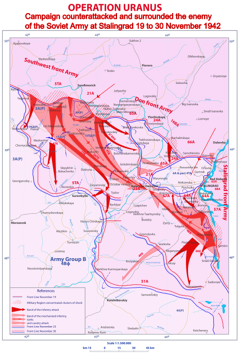
Soviet forces launched Operation Uranus on November 19, 1942, attacking from the north and south of Stalingrad in a massive pincer movement that closed behind the German Sixth Army four days later. The plan targeted the weaker Romanian and Italian units guarding the German flanks rather than the main German force. Over one million Soviet soldiers, 13,500 guns, 900 tanks, and 1,100 aircraft participated. The encirclement trapped 300,000 German soldiers in a pocket roughly 30 miles long and 20 miles wide. Hitler ordered Friedrich Paulus to hold Stalingrad at all costs. Hermann Goering promised an airlift that never materialized. A relief attempt by Erich von Manstein failed in December. Paulus surrendered on February 2, 1943. Only 91,000 of the original 300,000 survived to become prisoners. Fewer than 6,000 returned to Germany.
November 19, 1942
84 years ago
Key Figures & Places

What Else Happened on November 19
Pope Urban VIII consecrated the current Saint Peter’s Basilica, finalizing a construction project that spanned over a century and involved masters like Michelan…
Ricimer didn't want the throne. He wanted something better — the man sitting on it. When Libius Severus was declared Western Roman Emperor in 461, Ricimer, the …
Arab forces shattered the Sassanian army at the Battle of Qadisiya, ending Persian control over Mesopotamia. This victory dismantled the Sassanian defense of th…
Urban II didn't command kings. He commanded crowds. At Clermont, he preached to thousands gathered in an open field — the church couldn't hold them — and report…
Christopher Columbus went ashore on an island he named San Juan Bautista during his second voyage, claiming it for the Spanish Crown. The island, later renamed …

A prisoner known only by a number died in the Bastille on November 19, 1703, after decades of imprisonment during which his face was always concealed behind a m…
Talk to History
Have a conversation with historical figures who witnessed this era. Ask questions, explore perspectives, and bring history to life.