

Historical Figure
Constantine the Great
272–337
Roman emperor from 306 to 337
Talk to Constantine the Great
Have a conversation with this historical figure through AI
Biography
Constantine I, also known as Constantine the Great, or known mononymously as Constantine, was Roman emperor from AD 306 to 337 and the first Roman emperor to convert to Christianity. He played a pivotal role in elevating the status of Christianity in Rome, the Edict of Milan decriminalising Christian practice and ceasing Christian persecution. This was a turning point in the Christianisation of the Roman Empire. He founded the city of Constantinople and made it the capital of the Empire, which it remained for over a millennium.
In Their Own Words (2)
ἐν τούτῳ νίκα, [transliterated: en toutoi nika]
"In this sign thou shalt conquer" or "In this sign you will conquer", often rendered in its Latinized form: In hoc signo vinces; this motto is said to have been adopted by Constantine after his vision of a Chi Rho sign in the heavens just before his decisive battle with Maxentius, A.D. 312 , 2010
When we, Constantine and , emperors, had an interview at Milan, and conferred together with respect to the good and security of the commonweal, it seemed to us that, amongst those things that are profitable to mankind in general, the reverence paid to the Divinity merited our first and chief attention, and that it was proper that the Christians and all others should have liberty to follow that mode of religion which to each of them appeared best; so that that God, who is seated in heaven, might be benign and propitious to us, and to every one under our government. And therefore we judged it a salutary measure, and one highly consonant to right reason, that no man should be denied leave of attaching himself to the rites of the Christians, or to whatever other religion his mind directed him, that thus the supreme Divinity, to whose worship we freely devote ourselves, might continue to vouchsafe His favour and beneficence to us. And accordingly we give you to know that, without regard to any provisos in our former orders to you concerning the Christians, all who choose that religion are to be permitted, freely and absolutely, to remain in it, and not to be disturbed any ways, or molested. And we thought fit to be thus special in the things committed to your charge, that you might understand that the indulgence which we have granted in matters of religion to the Christians is ample and unconditional; and perceive at the same time that the open and free exercise of their respective religions is granted to all others, as well as to the Christians. For it befits the well-ordered state and the tranquillity of our times that each individual be allowed, according to his own choice, to worship the Divinity; and we mean not to derogate aught from the honour due to any religion or its votaries.
As translated in The Ante-Nicene Fathers (1886) edited by Alexander Roberts and James Donaldson, Vol. 7, p. 320 , 1886
Timeline
The story of Constantine the Great, told in moments.
His father dies at York, in Britain. The army declares Constantine emperor on the spot. He's one of six men claiming the title. Fifteen years of civil war begin.
Battle of the Milvian Bridge. The night before, he reportedly sees a cross in the sky, or dreams of one. He paints the Chi-Rho symbol on his soldiers' shields. He defeats Maxentius, whose army drowns in the Tiber. Constantine enters Rome as sole ruler of the West.
Issues the Edict of Milan with co-emperor Licinius. Christianity is legalized throughout the Roman Empire. Persecution ends. He returns confiscated church property and begins funding the construction of basilicas across the empire.
Convenes the Council of Nicaea. 318 bishops. He's not a theologian but he chairs the proceedings. They produce the Nicene Creed, defining core Christian doctrine. A Roman emperor is now settling arguments about the nature of God.
Dedicates Constantinople on the site of ancient Byzantium. A new capital for the empire. Rome is too far from the frontiers. Constantinople will endure as a capital for 1,123 years, outlasting Rome by a millennium.
Dies at Nicomedia. Baptized on his deathbed by an Arian bishop. He's 65. He converted an empire, moved its capital, and defined the relationship between church and state for the next seventeen centuries.
Artifacts (1)
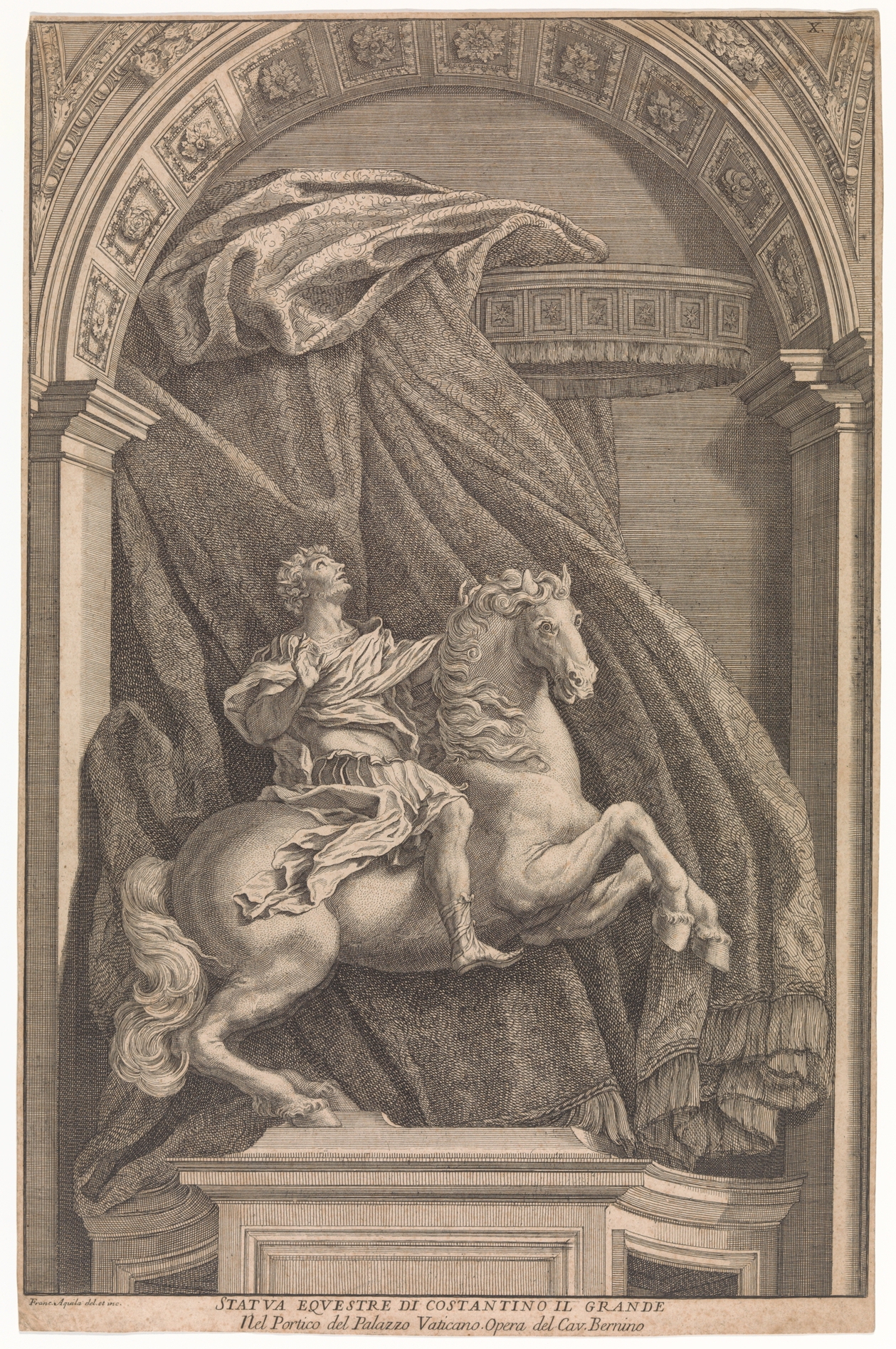
Equestrian Statue of Constantine the Great
Francesco Faraone Aquila|Gian Lorenzo Bernini
More from the Late Antiquity


Explore what happened on the days that shaped Constantine the Great's life. Today In History connects historical figures with the events, births, and deaths that defined their era. Browse all historical figures or explore today's events.