

Historical Figure
John Marshall
1755–1835
Chief Justice of the United States from 1801 to 1835
Talk to John Marshall
Have a conversation with this historical figure through AI
Biography
John Marshall was an American statesman, jurist, and Founding Father who served as the fourth chief justice of the United States from 1801 until his death in 1835. He remains the longest-serving chief justice and fourth-longest-serving justice in the history of the U.S. Supreme Court, and he is widely regarded as one of the most influential justices ever to serve. Prior to joining the court, Marshall briefly served as both the U.S. secretary of state under President John Adams and a U.S. representative from Virginia, making him one of the few Americans to have held a constitutional office in each of the three branches of the United States federal government.
In Their Own Words (5)
[T]he constitution controls any legislative act repugnant to it. … It is emphatically the province and duty of the Judicial Department to say what the law is. Those who apply the rule to particular cases must, of necessity, expound and interpret that rule. If two laws conflict with each other, the Courts must decide on the operation of each. So, if a law be in opposition to the Constitution, if both the law and the Constitution apply to a particular case, so that the Court must either decide that case conformably to the law, disregarding the Constitution, or conformably to the Constitution, disregarding the law, the Court must determine which of these conflicting rules governs the case. This is of the very essence of judicial duty. If, then, the Courts are to regard the Constitution, and the Constitution is superior to any ordinary act of the Legislature, the Constitution, and not such ordinary act, must govern the case to which they both apply. … Those then who controvert the principle that the constitution is to be considered, in court, as a paramount law, are reduced to the necessity of maintaining that courts must close their eyes on the constitution, and see only the law. This doctrine would subvert the very foundation of all written constitutions … It would be giving the legislature a practical and real omnipotence … The judicial power of the United States is extended to all cases arising under the constitution.
5. U.S. (1 Cranch) 137, at 177-188 , 1803
The convention which framed the Constitution was indeed elected by the State legislatures. But the instrument, when it came from their hands, was a mere proposal, without obligation or pretensions to it. It was reported to the then existing Congress of the United States with a request that it might "be submitted to a convention of delegates, chosen in each State by the people thereof, under the recommendation of its legislature, for their assent and ratification." This mode of proceeding was adopted, and by the convention, by Congress, and by the State legislatures, the instrument was submitted to the people. They acted upon it in the only manner in which they can act safely, effectively and wisely, on such a subject — by assembling in convention. It is true, they assembled in their several States — and where else should they have assembled? No political dreamer was ever wild enough to think of breaking down the lines which separate the States, and of compounding the American people into one common mass. Of consequence, when they act, they act in their States. But the measures they adopt do not, on that account, cease to be the measures of the people themselves, or become the measures of the State governments. From these conventions the Constitution derives its whole authority. The government proceeds directly from the people; is "ordained and established" in the name of the people, and is declared to be ordained, "in order to form a more perfect union, establish justice, insure domestic tranquillity, and secure the blessings of liberty to themselves and to their posterity." The assent of the States in their sovereign capacity is implied in calling a convention, and thus submitting that instrument to the people. But the people were at perfect liberty to accept or reject it, and their act was final. It required not the affirmance, and could not be negatived, by the State Governments. The Constitution, when thus adopted, was of complete obligation, and bound the State sovereignties.
17 U.S. (4 Wheaton) 316, 403-404 , 1819
The subject is the execution of those great powers on which the welfare of a Nation essentially depends. It must have been the intention of those who gave these powers, to insure, as far as human prudence could insure, their beneficial execution. This could not be done by confiding the choice of means to such narrow limits as not to leave it in the power of Congress to adopt any which might be appropriate, and which were conducive to the end. This provision is made in a constitution intended to endure for ages to come, and, consequently, to be adapted to the various crises of human affairs.
17 U.S. (4 Wheaton) 316, 415. Regarding the Necessary and Proper Clause in context of the powers of Congress. , 1819
The people made the Constitution, and the people can unmake it. It is the creature of their own will, and lives only by their will.
Cohens v. Virginia, 19 U.S. (6 Wheaton) 264, 387 (1821) , 1821
It has been said, that the people had already surrendered all their powers to the State sovereignties, and had nothing more to give. But, surely, the question whether they may resume and modify the powers granted to government does not remain to be settled in this country. Much more might the legitimacy of the general government be doubted, had it been created by the States. The powers delegated to the State sovereignties were to be exercised by themselves, not by a distinct and independent sovereignty, created by themselves. To the formation of a league, such as was the confederation, the State sovereignties were certainly competent. But when, "in order to form a more perfect union," it was deemed necessary to change this alliance into an effective government, possessing great and sovereign powers, and acting directly on the people, the necessity of 'referring it to the people, and of deriving its powers directly from them, was felt and acknowledged by all.
17 U.S. (4 Wheaton) 316, 405 , 1819
Timeline
The story of John Marshall, told in moments.
Served in the Continental Army at Valley Forge. The brutal winter shaped his belief in a strong central government. Studied law for six weeks and passed the Virginia bar.
Sworn in as Chief Justice of the United States. Appointed by John Adams in the final weeks of his presidency. Marshall would serve for 34 years under six presidents.
Issued the Marbury v. Madison ruling. Declared an act of Congress unconstitutional for the first time. Established judicial review. The most consequential Supreme Court decision in American history.
Artifacts (12)

John Marshall
Charles Balthazar Julien Févret de Saint-Mémin


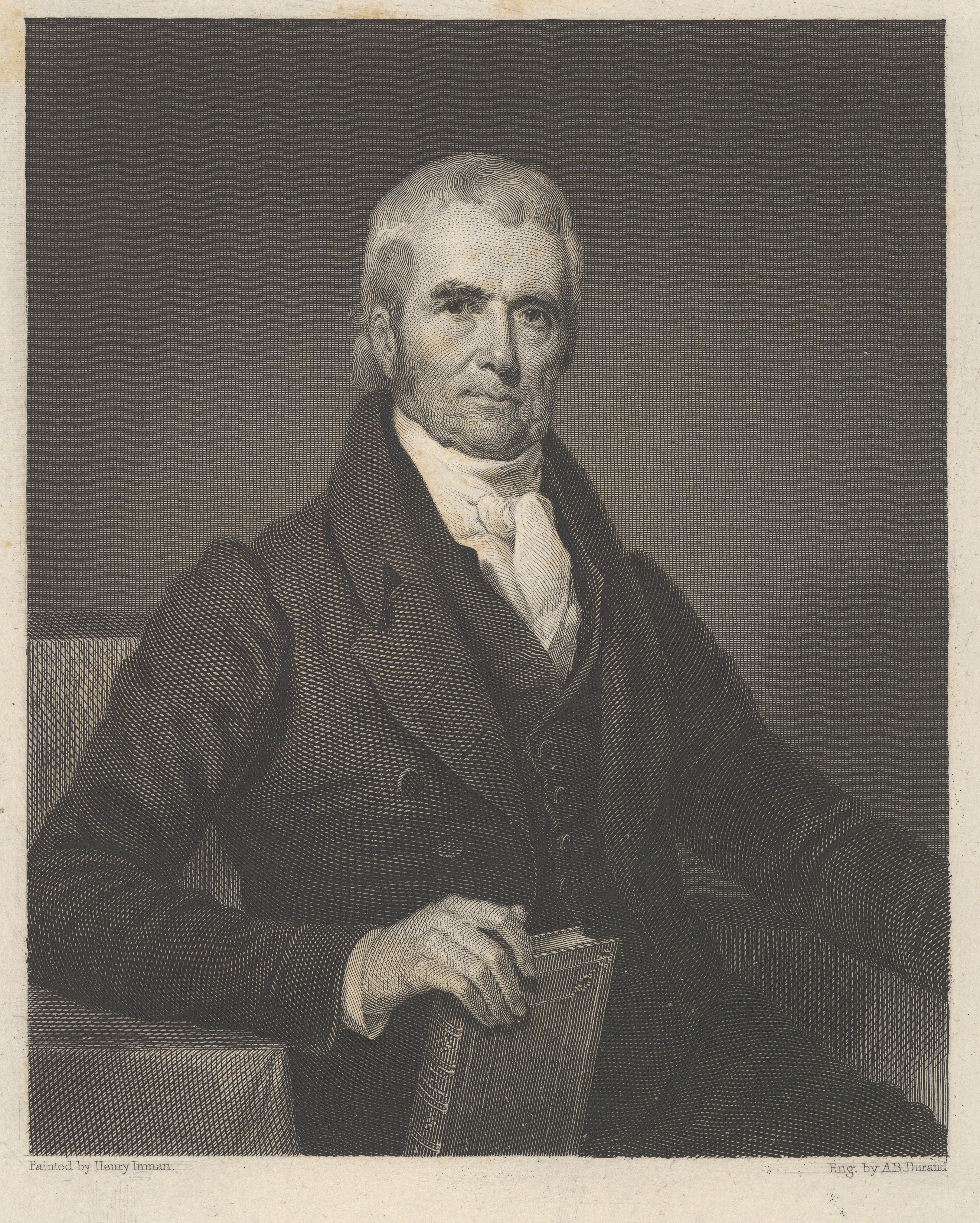
Chief Justice John Marshall
Asher Brown Durand|Henry Inman|John Marshall
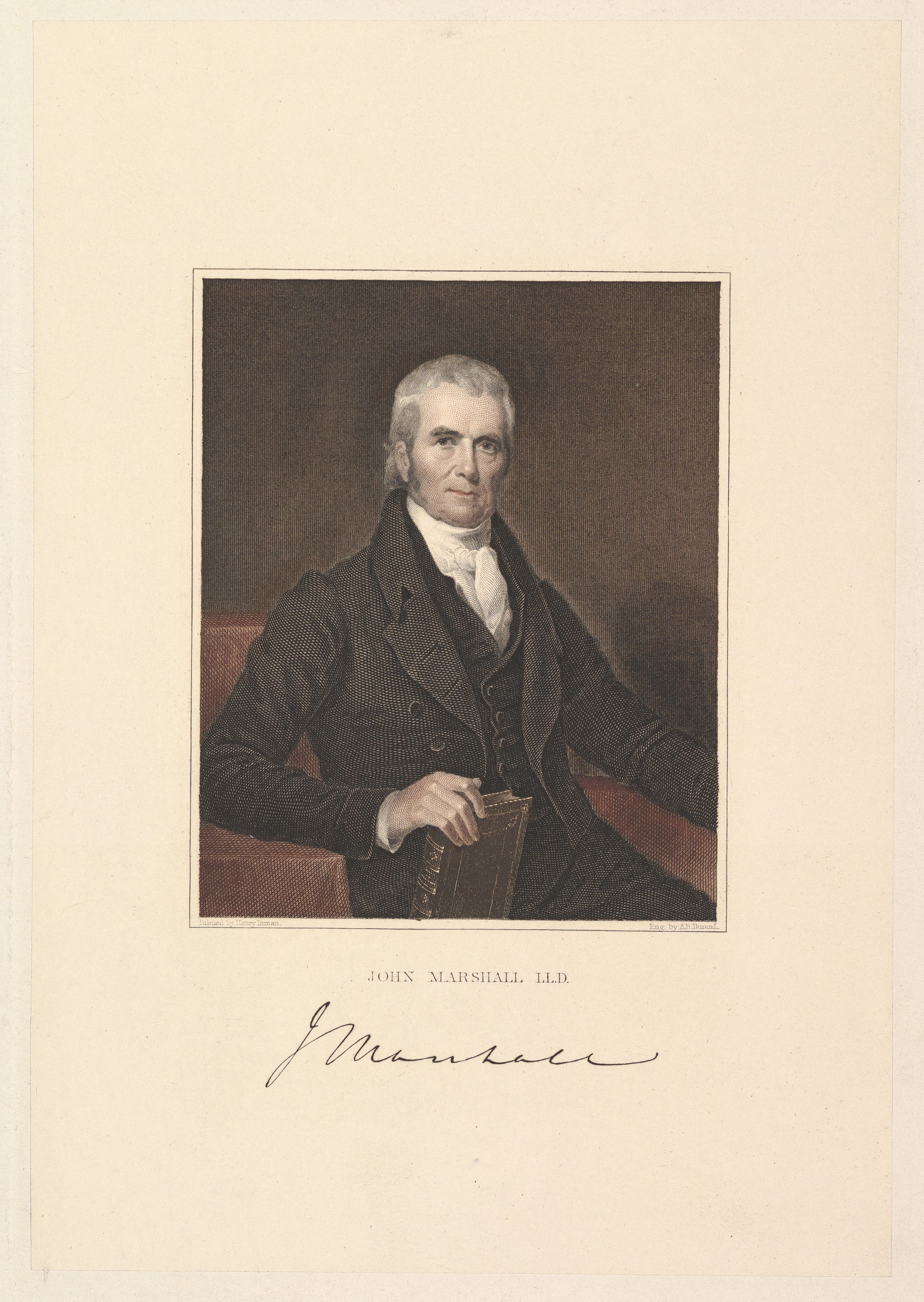
Chief Justice John Marshall
Asher Brown Durand|Henry Inman|John Marshall


John Marshall
E. B. & E. C. Kellogg Lithography Company, active c. 1842 - 1867


More from the Industrial Revolution


Explore what happened on the days that shaped John Marshall's life. Today In History connects historical figures with the events, births, and deaths that defined their era. Browse all historical figures or explore today's events.